
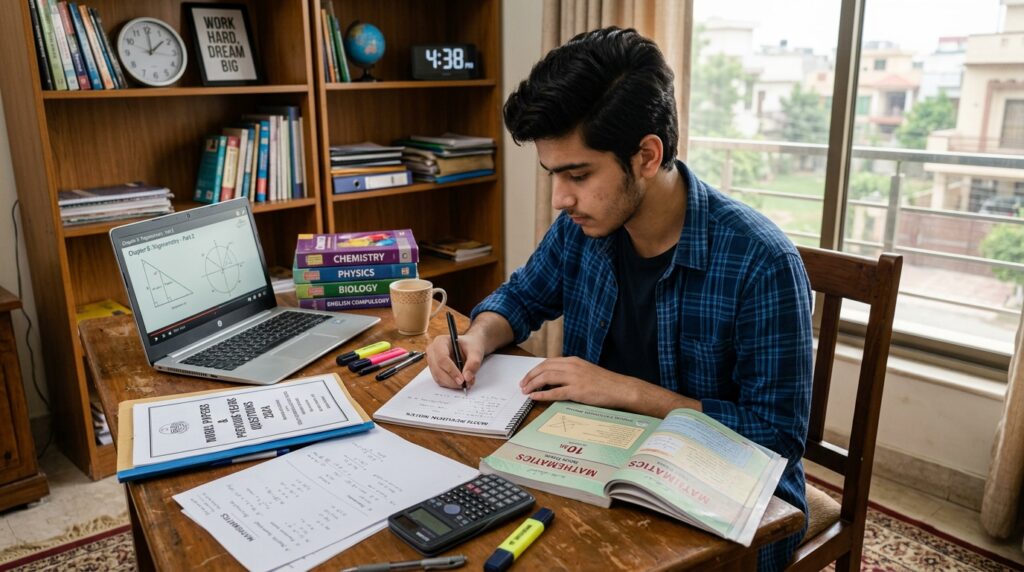
Matriculation in Pakistan refers to the Secondary School Certificate (SSC) level, which covers Classes 9 and 10. A student is commonly called “Matric pass” after successfully completing Class 10 or SSC Part II. After Matric, students can continue to Intermediate programs such as FSc, FA, ICS and ICom, move to A Levels, or explore technical and vocational education.
This guide explains what matriculation means in Pakistan, which classes and subjects it includes, how it compares with O Levels, how the grading system works and what students can study after completing Matric.
What Does Matriculation Mean?
Matriculation generally refers to completing a secondary level of education that allows a student to progress to the next academic stage.
In Pakistan, the term is commonly used for the Secondary School Certificate (SSC) qualification.
The SSC stage normally consists of:
- Class 9 — SSC Part I
- Class 10 — SSC Part II
- Completion of Class 10 — Matriculation/SSC completed
So, when someone in Pakistan says:
“I have completed my Matric.”
They usually mean that they have successfully completed their Class 10/SSC examinations.
Matric examinations are conducted through educational boards such as the Federal Board and provincial Boards of Intermediate and Secondary Education.
Students looking for academic support can also explore online tuition in Pakistan for Matric, Intermediate, Cambridge and other education systems.
Matriculation Means Which Class in Pakistan?
One of the most common questions students ask is: Matric is which class?
The simplest answer is:
Matric is the secondary education stage covering Classes 9 and 10, while a student officially completes Matric after passing Class 10.
Here is the typical progression:
| Education Stage | Class/Grade | Qualification |
| Primary | Classes 1–5 | Primary Education |
| Middle | Classes 6–8 | Middle School |
| Secondary | Class 9 | SSC Part I |
| Secondary | Class 10 | SSC Part II / Matric |
| Higher Secondary | Class 11 | HSSC Part I |
| Higher Secondary | Class 12 | HSSC Part II / Intermediate |
This distinction is important because people sometimes use “Matric” only for Class 10, while academically the SSC programme spans both Classes 9 and 10.
What Is SSC? Is SSC the Same as Matric?
Yes. In everyday Pakistani education terminology, SSC and Matric generally refer to the same secondary qualification.
SSC stands for:
Secondary School Certificate
Students normally complete SSC after studying Classes 9 and 10 and passing the examinations required by their respective education board.
You may therefore see different wording on documents:
- Matric
- Matriculation
- SSC
- Secondary School Certificate
- SSC Part I
- SSC Part II
SSC Part I refers to Class 9, while SSC Part II refers to Class 10.
How Does Matric Work in Pakistan?
Pakistan has several examination boards responsible for secondary and higher secondary education.
Depending on where a student studies, they may fall under boards such as:
- Federal Board of Intermediate and Secondary Education (FBISE)
- BISE Lahore
- BISE Rawalpindi
- BISE Multan
- BISE Faisalabad
- BISE Gujranwala
- BISE Peshawar
- Board of Secondary Education Karachi
- Hyderabad Board
- Sukkur Board
- Aga Khan University Examination Board (AKU-EB)
Although curriculum structure, assessment methods and subject combinations can vary somewhat by board or province, the basic Matric pathway remains the same: secondary education through Classes 9 and 10 followed by progression to higher secondary education.
Gradelao provides online tutoring for Pakistani students across local boards as well as Cambridge and international qualifications.
What Subjects Are Studied in Matric?
Matric subjects depend on the student’s education board, province and chosen academic group.
The two commonly recognised pathways are science-oriented and humanities/arts-oriented combinations.
Common Matric Science Subjects
Students in a science-focused group commonly study subjects such as:
- English
- Urdu
- Mathematics
- Physics
- Chemistry
- Biology or Computer Science
- Pakistan Studies
- Islamiyat
Students interested in medicine typically choose Biology, while students interested in technology or computing may choose Computer Science where available.
Common Arts and Humanities Subjects
Depending on the board and available subject combinations, students may study:
- English
- Urdu
- Mathematics or General Mathematics
- General Science
- Pakistan Studies
- Islamiyat
- Education
- Civics
- Economics
- Home Economics
- Other approved electives
The exact scheme of studies should always be checked with the student’s school and examination board because subject requirements can differ.
Matric Science or Arts: Which Should You Choose?
The better choice depends on what the student wants to study later.
A science pathway may suit students interested in areas such as:
- Medicine
- Engineering
- Computer Science
- Data and technology
- Natural sciences
Humanities or arts-related combinations may suit students interested in:
- Business
- Media
- Education
- Social sciences
- Languages
- Law
- Arts and creative fields
However, students should not select a group simply because one is considered more prestigious.
Their interests, strengths and future admission requirements should guide the decision.
Matric vs O Levels in Pakistan
Matric and O Levels are two major secondary education routes available to students in Pakistan.
They operate differently, but Cambridge O Levels can be recognised as equivalent to Pakistan’s Secondary School Certificate when the relevant IBCC requirements are fulfilled.
Here is a simple comparison:
| Feature | Matric | O Levels |
| Education level | Secondary School Certificate | Secondary-level international qualification |
| Typical stage | Classes 9–10 | Usually studied during the secondary-school years |
| Examination system | Pakistani education boards | Cambridge International |
| Curriculum | Pakistani/local board curriculum | International Cambridge curriculum |
| Assessment | Board-based examinations | Cambridge examinations |
| Language of instruction | Depends on school/board | Primarily English |
| Learning approach | Varies by board and school | Strong emphasis on conceptual and analytical learning |
| Cost | Generally more affordable | Generally more expensive |
| Recognition in Pakistan | Direct local recognition | IBCC equivalence may be required |
| International portability | Primarily local/national | Widely used internationally |
| Common next step | FSc, FA, ICS, ICom | A Levels or other higher-secondary pathways |
If you want a deeper explanation of the international system, read our guide on O Level means which class in Pakistan.
Students preparing for Cambridge examinations can also explore Cambridge O Level online tuition for subject-specific support.
Is Matric Equal to O Levels?
They are comparable at the secondary education level, but they are not identical qualifications.
For Pakistani equivalence purposes, GCSE, IGCSE and GCE O Level qualifications can be considered equivalent to SSC when IBCC’s required subject and equivalence conditions are met. Pakistani students appearing from Pakistan must also meet specific compulsory-subject requirements.
This distinction matters particularly when an O Level student wants to:
- Join an FSc or other Intermediate programme
- Apply to a Pakistani college
- Apply for certain university programmes
- Submit qualifications for employment
- Calculate local merit percentages
In such situations, the student may need an official IBCC equivalence certificate.
Matric or O Levels: Which Is Better?
There is no single answer that works for every student.
Matric may be a better fit if:
- You plan to continue through Pakistan’s FSc, ICS, FA or ICom system.
- Affordability is an important consideration.
- Your preferred schools and colleges follow Pakistani boards.
- You expect to continue most of your education in Pakistan.
- You are comfortable with the local examination system.
O Levels may be a better fit if:
- You prefer an internationally structured curriculum.
- You may study abroad later.
- You plan to continue to A Levels.
- You prefer conceptual and analytical assessment.
- Your family can comfortably manage the additional examination and schooling costs.
Neither system automatically makes a student more successful.
The quality of teaching, study habits, subject selection, academic support and the student’s own effort often matter more than the name of the qualification.
How Are Matric Students Graded?
Pakistan is moving toward a revised national grading framework for SSC and HSSC examinations.
According to IBCC, the new system is a 10-point grading system, and its first implementation phase began in 2026 for Grade 9 (SSC) and Grade 11 (HSSC). The new framework also sets the passing threshold at 40%.
Because implementation is being phased in, students should check the latest grading and result rules issued by their own examination board rather than relying on older percentage-to-grade charts found online.
This is particularly important for students appearing in board examinations during the transition period.
Why Is Matric Important in Pakistan?
Matric is one of the first major academic milestones in a Pakistani student’s education.
The result can affect several important next steps.
College Admissions
Colleges consider SSC results when admitting students to Intermediate programmes.
Choice of Academic Stream
Performance and subjects at Matric level can influence whether students pursue FSc, ICS, ICom, FA or another qualification.
Scholarships
Strong academic performance may help students qualify for merit-based scholarships or fee concessions.
Entry-Level Employment
Some positions in Pakistan specify “Matric pass” as a minimum educational qualification.
Foundation for Higher Education
Matric-level Mathematics, English, Science and other subjects provide the foundation for more advanced study in Classes 11 and 12.
What Comes After Matric in Pakistan?
After completing Matric, students have several options.
The right choice depends on their subjects, interests and long-term career plans.
1. FSc Pre-Medical
Students interested in medicine and health sciences commonly select FSc Pre-Medical.
Major subjects typically include:
- Biology
- Chemistry
- Physics
This pathway can lead toward fields such as medicine, dentistry, pharmacy and biological sciences, subject to university admission requirements.
2. FSc Pre-Engineering
Students interested in engineering and mathematics-heavy fields may choose FSc Pre-Engineering.
Core subjects commonly include:
- Mathematics
- Physics
- Chemistry
3. ICS
ICS stands for Intermediate in Computer Science.
It is a popular option for students interested in:
- Computer Science
- Software Engineering
- Artificial Intelligence
- Data Science
- Information Technology
- Related technology fields
Subject combinations can vary between boards and colleges.
4. ICom
ICom stands for Intermediate in Commerce.
It can provide a foundation for:
- Accounting
- Finance
- Business
- Banking
- Commerce
- Entrepreneurship
5. FA
FA is a humanities-oriented Intermediate pathway that can include subjects related to:
- Social sciences
- Languages
- Education
- Psychology
- Sociology
- Fine arts
- Other humanities disciplines
6. A Levels
Students are not necessarily locked into the local Intermediate system after Matric.
IBCC states that a student who has completed SSC/Matric can pursue A Levels because SSC is treated as an equivalent entry-level qualification to O Levels for this progression.
Students considering this route can learn more about Cambridge A Level online tuition and subjects.
7. Technical and Vocational Education
University is not the only option.
Depending on eligibility and career goals, students can also explore technical education, vocational qualifications and diploma programmes.
Frequently Asked Questions About Matriculation
What is matriculation in Pakistan?
Matriculation in Pakistan refers to the Secondary School Certificate or SSC stage. It covers Classes 9 and 10, with students commonly considered Matric pass after successfully completing Class 10.
Matric is which class?
Matric education includes Classes 9 and 10. Class 9 is SSC Part I and Class 10 is SSC Part II. The Matric qualification is completed after passing Class 10.
Is Class 10 called Matric?
Yes. In everyday usage in Pakistan, Class 10 is commonly called Matric because it is the final year of the SSC qualification.
Is SSC the same as Matric?
Yes. SSC stands for Secondary School Certificate and is commonly known as Matric or Matriculation in Pakistan.
Is Matric equal to O Levels?
O Levels can be considered equivalent to SSC/Matric in Pakistan when the subject and equivalence requirements established by IBCC are fulfilled. They are equivalent in academic level for official purposes but follow different curricula and examination systems.
What subjects are studied in Matric?
Common subjects include English, Urdu, Mathematics, Pakistan Studies, Islamiyat and elective or group subjects such as Physics, Chemistry, Biology, Computer Science and humanities subjects. Exact combinations depend on the education board and selected group.
How many years is Matric in Pakistan?
The SSC/Matric stage normally lasts two academic years: Class 9 and Class 10.
What can I study after Matric?
Common options include FSc Pre-Medical, FSc Pre-Engineering, ICS, ICom, FA, A Levels and technical or vocational education.
Can I do A Levels after Matric?
Yes. Students who complete SSC/Matric can move to A Levels. IBCC recognises SSC as an appropriate equivalent qualification for this progression.
Which is better, Matric or O Levels?
Neither is universally better. Matric is generally more affordable and integrates directly with Pakistan’s local education system, while O Levels provide an international curriculum and may suit students planning to continue to A Levels or international education.
Final Thoughts
Matriculation is one of the most important stages in Pakistan’s school education system.
In simple terms, Matric means completing the SSC level through Classes 9 and 10, with the qualification completed after Class 10.
From there, students can choose from multiple pathways, including FSc, ICS, ICom, FA, A Levels and technical education.
Parents and students should choose the next step based on future university plans, career interests, subject strengths, learning preferences and budget rather than simply following what everyone else is doing.
If you are comparing local and international education systems, our guide explaining what class O Level means in Pakistan is a useful next read.
Students who need personalised help with Matric, O Levels, Intermediate or other subjects can also explore Gradelao’s online tuition in Pakistan and learn with tutors experienced in their specific board and curriculum.