

Easiest IGCSE Subjects: 7 Options for High Grades (2026 Guide)
Choosing the easiest IGCSE subjects can help you build a subject combination that matches your strengths, interests, and future academic goals. Some students find Business Studies easier to understand, while others perform better in ICT, English as a Second Language, or Art & Design. However, the easiest IGCSE subject depends on your abilities, the syllabus you study, and the assessment methods used.
For students comparing Cambridge IGCSE and other international qualifications, choosing the right subjects requires more than looking for high-scoring options. You should also consider future A Level requirements, university admission criteria, coursework demands, and examination preparation.
In this guide, we explore seven IGCSE subjects that some students may find more manageable, explain their potential challenges, and share practical advice for selecting subjects that support strong academic results.
If you need help understanding your options, explore GradeLao’s Cambridge IGCSE online classes for personalised academic support.
What Are the Easiest IGCSE Subjects?
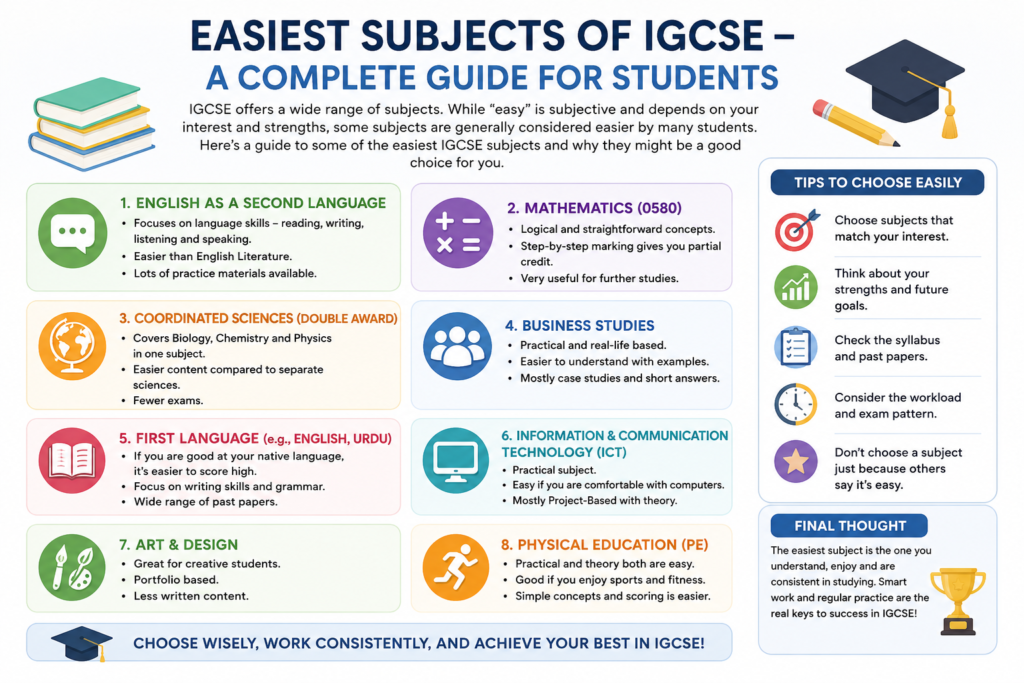
There is no officially established ranking of the easiest IGCSE subjects for every student. However, subjects such as Business Studies, English as a Second Language, ICT, Environmental Management, Travel & Tourism, Art & Design, and Physical Education may suit particular learning styles.
The following comparison provides a starting point for evaluating these subjects.
| IGCSE subject | May suit students who enjoy | Potential challenge |
|---|---|---|
| Business Studies | Real-world examples and analytical writing | Applying concepts to case studies |
| English as a Second Language | Reading, writing, and communication | Grammar, comprehension, and language accuracy |
| Information and Communication Technology (ICT) | Computers and practical digital tasks | Technical knowledge and practical accuracy |
| Environmental Management | Environmental issues and real-world examples | Applying concepts and interpreting information |
| Travel & Tourism | Travel, hospitality, and customer service | Case studies and structured responses |
| Art & Design | Creativity and visual experimentation | Portfolio development and time management |
| Physical Education | Sports, fitness, and human performance | Theory and practical assessment requirements |
Important: This comparison is a general guide, not an official difficulty ranking. Subject availability, syllabus content, examination components, and assessment requirements can differ between qualifications and examination sessions.
1. Business Studies
Business Studies may be a manageable IGCSE option for students who enjoy understanding how companies operate and make decisions. It connects classroom concepts with familiar examples involving customers, marketing, employees, finance, and business growth.
Why Business Studies May Feel Easier
Students who enjoy explaining ideas, interpreting business scenarios, and applying knowledge to real-world situations may find the subject engaging. It generally focuses more on business concepts, reasoning, and application than on advanced mathematical calculations.
However, students still need to learn key terminology, interpret case studies, and explain the consequences of business decisions.
Key Topics
- Business activity and entrepreneurship
- Marketing and market research
- Human resource management
- Business operations
- Finance and business growth
- External influences on businesses
Who Should Choose Business Studies?
It may suit students interested in business management, marketing, entrepreneurship, economics, or related careers.
How to Score Higher
Practise case-study questions and learn to apply business concepts directly to the information provided. Develop structured answers that explain a point, apply it to the scenario, and evaluate its likely impact where required.
2. English as a Second Language
English as a Second Language (ESL) may suit students who already have a reasonable foundation in English and want to develop their communication skills.
The subject focuses on practical language use, which can be helpful for students preparing for further education in an English-speaking academic environment.
Why ESL May Be Manageable
Students who regularly read English, understand written information, and communicate confidently may find some parts of the subject familiar. Nevertheless, examination performance depends on the relevant syllabus and the skills being assessed.
Students may need to practise reading comprehension, writing, listening, speaking, or other specified assessment components.
Who Should Choose ESL?
ESL may be appropriate for students who want to strengthen their academic English and already meet the entry and subject-selection requirements for their chosen qualification.
How to Score Higher
Read English articles regularly, practise writing under time limits, expand your vocabulary, and review recurring grammar mistakes. Use past papers to understand the examination format and marking expectations.
3. Information and Communication Technology (ICT)
ICT may appeal to students who enjoy computers, digital applications, and practical problem-solving. Depending on the syllabus, the subject may combine theoretical knowledge with practical tasks involving common computer applications and information systems.
Why ICT May Be Manageable
Students who are already comfortable with computers may recognise some of the tools and concepts they encounter. Practical activities can also help them understand how digital systems work.
However, familiarity with everyday computer use does not automatically translate into strong examination results. Students must learn the required theory and complete practical tasks accurately.
Key Areas to Explore
- Word processing and document formatting
- Spreadsheets and data handling
- Databases
- Presentations
- Digital communication
- Information systems and data management
The exact topics depend on the examination board and syllabus.
How to Score Higher
Practise the required computer-based tasks rather than relying exclusively on notes. Learn the correct procedures, review common errors, and practise completing tasks within the specified time.
4. Environmental Management
Environmental Management may suit students who are interested in nature, geography, sustainability, and the relationship between people and the environment.
It can provide opportunities to connect academic concepts with real-world issues such as pollution, energy use, conservation, agriculture, and natural resources.
Why Environmental Management May Be Manageable
Students who enjoy understanding real-world problems may find the subject engaging. Using practical examples can make complex environmental concepts easier to understand and remember.
However, students still need to interpret information, explain environmental processes, and apply their knowledge to unfamiliar scenarios.
Key Topics
- Natural resources and energy
- Water and agriculture
- Pollution and waste management
- Conservation and biodiversity
- Population and development
- Environmental impacts and management
How to Score Higher
Use real-world examples in your revision, practise interpreting data and diagrams, and learn how to explain causes, effects, and possible solutions to environmental problems.
Before selecting the subject, review the relevant syllabus to understand its content and assessment structure.
5. Travel & Tourism
Travel & Tourism may be an appealing option for students interested in hospitality, travel, destinations, customer service, and tourism businesses.
The subject explores how tourism operates and how destinations, organisations, visitors, and local communities interact.
Why Travel & Tourism May Feel Accessible
Many topics relate to situations students can recognise from everyday life, including holidays, hotels, transport, customer experiences, and destination marketing.
However, students must still understand industry terminology, interpret case studies, and explain tourism-related issues using appropriate concepts.
Who Should Choose Travel & Tourism?
It may suit students interested in tourism management, hospitality, event planning, customer service, or related industries, where the subject is available and appropriate for their qualification.
How to Score Higher
Study examples of real destinations and tourism businesses. Practise structured responses, learn key terms, and connect your answers to the particular case study rather than giving only general information.
6. Art & Design
Art & Design may be a strong choice for students who enjoy drawing, visual communication, design, and creative experimentation.
Unlike subjects that may rely heavily on written examinations, Art & Design can involve developing ideas, exploring materials, producing artwork, and documenting creative decisions.
Why Art & Design May Suit Certain Students
Students who enjoy practical creative work may feel comfortable with its approach to learning and assessment. However, the subject should not automatically be considered easy.
Portfolio development, experimentation, planning, and completing work to the required standard can demand considerable time and commitment.
Skills You May Develop
- Drawing and observation
- Visual communication
- Creative problem-solving
- Design development
- Experimentation with techniques
- Portfolio organisation
How to Score Higher
Begin projects early, maintain organised records of your creative process, experiment with different approaches, and check the assessment criteria regularly. Strong ideas need careful development and execution.
7. Physical Education
Physical Education may appeal to students who enjoy sports, fitness, exercise, and understanding human performance.
Depending on the syllabus, students may study physical activity, training, health, performance, and related theoretical concepts alongside practical components.
Why Physical Education May Be Manageable
Students who enjoy physical activity may find the practical side motivating. However, sporting ability alone is not enough to perform well in the subject.
The balance between theory and practical assessment varies, so students should check the specific qualification requirements before making their decision.
How to Score Higher
Prepare consistently for theoretical examinations, understand the principles behind training and performance, and practise the practical components required by your syllabus.
Which IGCSE Subjects Are Easiest to Score High Grades In?
The subjects in which students achieve their strongest results depend on their academic strengths, preparation, teaching, and understanding of the assessment requirements.
A student who enjoys applying concepts to business scenarios may perform well in Business Studies. Someone with strong language skills may find ESL more manageable, while a creative student may be better suited to Art & Design.
Rather than assuming that one subject produces higher grades for everyone, compare these factors:
- Prior knowledge: Do you already understand some of the subject?
- Interest: Are you willing to study it consistently?
- Assessment style: Do you prefer written examinations, practical work, or coursework?
- Available support: Can you access suitable teachers, resources, and practice materials?
- Future relevance: Will the subject support your intended A Level or university pathway?
You can also explore GradeLao’s IGCSE study tips and techniques to learn how consistent revision and effective exam preparation can support better results.
How to Choose the Right IGCSE Subjects
Choosing subjects is an important academic decision. The right combination should balance your interests, strengths, future plans, and the requirements of your school or examination board.
1. Consider Your Future Career Goals
Think about the subjects you may need for your intended A Level courses or university degree.
For example:
- Medicine: Biology, Chemistry, and other required science or mathematics subjects.
- Engineering: Mathematics, Physics, and other relevant sciences.
- Business and management: Business Studies, Economics, Mathematics, or related options.
- Computing and technology: Mathematics, Computer Science, Physics, or ICT, depending on your pathway.
- Creative careers: Art & Design and other relevant creative subjects.
- Humanities and social sciences: History, Geography, Literature, and other relevant subjects.
These are general examples, not universal admission requirements. Check the requirements of the schools, colleges, and universities you may apply to.
2. Identify Your Academic Strengths
Ask yourself a few questions before choosing:
- Do I enjoy writing and explaining ideas?
- Am I comfortable with mathematics and scientific concepts?
- Do I prefer practical tasks or written examinations?
- Do I enjoy analysing information and solving problems?
- Do I work well on long-term creative projects?
Your answers can help you identify subjects that match your learning preferences.
3. Compare the Assessment Methods
Two subjects that seem equally interesting may have very different assessment requirements.
Review whether each subject includes written examinations, practical assessments, coursework, portfolios, listening tests, or speaking components, where applicable.
Understanding these requirements early can help you avoid choosing a subject whose workload does not suit you.
4. Review the Current Syllabus
Before finalising your choices, check the current syllabus for your examination board and session. Review the topics, assessment objectives, number of papers, and any coursework or practical requirements.
For Cambridge students, the Cambridge IGCSE syllabus changes for 2026–2027 guide may also be useful when checking for relevant updates.
5. Plan for Your Next Qualification
Your IGCSE subjects can affect your preparation for A Levels and other further education options.
If you already have an idea of what you want to study next, explore the A Level subject selection guide and check the entry requirements for the courses you are considering.
IGCSE Subject Combinations for Different Career Goals
The following examples can help you begin planning a subject combination. They are not fixed recommendations, and availability varies by school and examination board.
Business and Management
Possible options include Business Studies, Economics, Mathematics, and ICT.
Technology and Computing
Possible options include Mathematics, Computer Science, ICT, and Physics.
Creative Industries
Possible options include Art & Design, English, ICT, and Business Studies.
Humanities and Social Sciences
Possible options include History, Geography, Literature, and other humanities subjects offered by your school.
Science-Based Careers
Students considering medicine, engineering, or other science-based degrees should carefully review the relevant science and mathematics requirements before selecting their IGCSE subjects.
There is no single ideal combination for every student. Your school’s available subjects and your intended academic pathway should guide the final decision.
Easy vs High-Scoring IGCSE Subjects: What Is the Difference?
A subject that feels easy to understand does not necessarily guarantee a high grade. Likewise, a challenging subject can produce excellent results when a student has strong foundations and prepares effectively.
High performance generally depends on several factors:
- Understanding the syllabus and assessment objectives
- Developing strong subject knowledge
- Practising examination-style questions
- Managing time effectively
- Reviewing mistakes and weak topics
- Following a consistent revision schedule
For example, a student may understand Business Studies concepts quickly but lose marks by failing to apply them to case studies. Another student may enjoy Art & Design but struggle to finish a portfolio on time.
The most suitable subject is usually one in which your interests, abilities, and preparation habits work together.
How to Improve Your IGCSE Grades
Once you have selected your subjects, focus on developing an effective preparation routine.
Create a Realistic Study Schedule
Divide your available study time between subjects according to their workload and your current performance. Include regular revision sessions rather than leaving everything until the examination period.
Practise Past Papers
Past papers help you become familiar with question formats, marking expectations, and time limits. Use examiner reports and mark schemes where available to identify recurring mistakes.
For additional preparation, see GradeLao’s IGCSE past papers guide.
Understand Concepts Instead of Memorising Everything
Memorisation can help with definitions and essential facts, but many questions require you to apply knowledge to new situations. Practise explaining concepts in your own words and using them to answer examination questions.
Review Your Mistakes
Keep a record of incorrect answers and the reasons you lost marks. Group these mistakes by topic, then revisit the relevant concepts before attempting similar questions again.
Practise Under Time Limits
Complete practice papers under realistic examination conditions. This helps you identify questions that take too long and develop a better strategy for allocating your time.
Get Support When You Need It
If a topic remains difficult despite regular revision, a qualified tutor can help identify gaps in your understanding and provide targeted practice.
Students following the Cambridge curriculum can explore GradeLao’s Cambridge IGCSE online tutoring for individual academic support.
Cambridge IGCSE vs Edexcel International GCSE: Does Subject Difficulty Differ?
Students should not assume that a subject is easier simply because it belongs to a particular examination board. Cambridge IGCSE and Pearson Edexcel International GCSE qualifications can differ in syllabus content, assessment structure, and examination requirements.
The comparison should be made subject by subject rather than by treating either board as universally easier.
When comparing qualifications, review:
- Topics and syllabus content
- Number and structure of examination papers
- Practical or coursework requirements
- Assessment objectives and question styles
- Entry requirements for future courses
Students considering Pearson Edexcel can explore GradeLao’s Edexcel IGCSE online tuition. Those comparing Cambridge and Edexcel should also check the relevant official syllabus documents before making a final decision.
Why Choose GradeLao for IGCSE Preparation?
Selecting the right subjects is only the beginning. Consistent teaching, personalised guidance, and regular examination practice can help students understand their subjects and prepare more effectively.
GradeLao provides academic support for students following international curricula, with learning support tailored to individual needs.
Students can explore options such as:
- Individual online tutoring
- Cambridge IGCSE subject preparation
- Support with challenging topics
- Examination-focused practice
- Personalised learning plans
- Progress monitoring and feedback
Explore GradeLao’s Cambridge IGCSE online classes to learn more about available support. If you are ready to discuss your requirements, visit the GradeLao enrollment page to enquire about classes and suitable tutoring options.
Frequently Asked Questions
What is the easiest IGCSE subject?
There is no universally easiest IGCSE subject. Business Studies, ICT, ESL, Environmental Management, Travel & Tourism, Art & Design, and Physical Education may suit certain students, depending on their strengths, interests, syllabus, and assessment preferences.
Which IGCSE subjects are easiest to score high grades in?
The answer depends on the student. Subjects that match your existing knowledge, interests, and preferred assessment style may be more manageable. Regular revision, subject understanding, and examination practice are essential for achieving strong grades.
Is Business Studies easy in IGCSE?
Business Studies may suit students who enjoy real-world business examples, analytical thinking, and written explanations. However, students must understand key concepts and apply them accurately to case studies.
Is ICT an easy IGCSE subject?
ICT may feel more accessible to students who are comfortable with computers and practical digital tasks. The subject still requires theoretical understanding and accurate completion of the relevant practical or examination components.
Is Art & Design an easy IGCSE subject?
Not necessarily. Art & Design can suit creative students, but portfolio development, experimentation, deadlines, and assessment requirements can make it demanding.
Which IGCSE subjects should I choose for medicine?
Students considering medicine should review the science and mathematics requirements for their intended A Level courses and universities. Biology and Chemistry are often important for medical pathways, but specific entry requirements vary by institution and country.
Can I choose IGCSE subjects based only on difficulty?
It is better to balance difficulty with academic strengths, personal interests, future education plans, and assessment requirements. A subject that seems easy but does not support your future goals may not be the best long-term choice.
Is Cambridge IGCSE easier than Edexcel International GCSE?
Neither examination board is universally easier. The experience depends on the subject, syllabus, assessment format, and individual student. Compare the relevant specifications and past papers before deciding.
How can I get help with IGCSE preparation?
You can seek support from qualified teachers, use official syllabus documents, practise past papers, and follow a structured revision plan. Students seeking personalised support can explore GradeLao’s Cambridge IGCSE online classes.
Final Thoughts
The easiest IGCSE subjects are not the same for every student. Business Studies may suit someone who enjoys analysing real-world situations, while ICT may appeal to a student who likes technology. A creative learner may prefer Art & Design, whereas someone interested in environmental issues may enjoy Environmental Management.
The best approach is to choose subjects that balance your strengths, interests, preferred assessment methods, and future academic goals. Review the syllabus, check your intended A Level or university requirements, and consider the workload before making your final decision.
With consistent preparation, effective exam techniques, and the right academic support, you can build confidence and work towards stronger IGCSE results.
Explore GradeLao’s Cambridge IGCSE tutoring or visit the enrollment page to discuss your learning needs and next steps.