
Getting your target IELTS band score requires more than simply practising sample questions. Whether you are preparing for university admission, professional registration, international employment, migration, or another English-language requirement, a structured IELTS preparation course can help you understand the test, identify your weaknesses, and practise with a clear strategy.
GradeLao offers online IELTS preparation with personalised tutor support, helping students prepare for Academic and General Training IELTS from anywhere in the world. You can study online, receive individual feedback, practise all four test sections, and build a preparation plan around your target band score and exam timeline.
If you are comparing self-study with professional IELTS tutoring, this guide explains what to expect from an IELTS preparation course, what you should look for in a tutor, typical pricing considerations, expected learning outcomes, and how to choose the right preparation approach.
What Is IELTS and Who Needs IELTS Preparation?
The International English Language Testing System (IELTS) is one of the world’s most widely recognised English proficiency tests. It assesses four core skills:
- Listening
- Reading
- Writing
- Speaking
IELTS is commonly used for:
- University and college admissions
- Professional registration
- International employment
- Skilled migration
- Visa and immigration applications
- Academic and professional English requirements
There are two main IELTS formats:
IELTS Academic is generally designed for higher education and professional registration.
IELTS General Training is commonly used for migration, employment, and other non-academic purposes.
Before enrolling in an IELTS course, identify which test you need and confirm the score requirements of your university, employer, professional body, or immigration authority.
Why Choose an Online IELTS Preparation Course?
Online IELTS preparation gives students the flexibility to study from almost anywhere without being restricted by location. However, the biggest advantage of a structured online course is not simply convenience—it is guided preparation and personalised feedback.
A good IELTS tutor can identify patterns in your mistakes, explain why your answers are losing marks, and adjust your preparation according to your current level.
Online IELTS tutoring can be particularly useful if:
- You have a specific target band score
- You have limited preparation time
- You have taken IELTS before without achieving your target
- Your Writing or Speaking score is weaker than your Reading and Listening
- You need regular feedback on practice work
- You prefer learning with a personalised study plan
- You need flexible classes around work, university, or family commitments
For students preparing for other international qualifications alongside IELTS, GradeLao also provides Cambridge O Level online tuition, Cambridge IGCSE online tuition, and A Level online and tuition.
What Does an IELTS Preparation Course Include?
A complete IELTS preparation course should cover all four test components rather than focusing only on practice tests.
At GradeLao, IELTS preparation can be structured around your current English level, target band, test type, and available preparation time.
A typical course may include:
- IELTS Listening practice
- IELTS Academic or General Training Reading practice
- IELTS Writing Task 1 preparation
- IELTS Writing Task 2 preparation
- IELTS Speaking practice
- Vocabulary development
- Grammar improvement
- Question-type strategies
- Timed mock tests
- Individual performance analysis
- Writing corrections and feedback
- Speaking feedback
- Personalised study planning
- Progress monitoring
The objective is not simply to complete more practice papers. It is to understand why you are losing marks and what you need to change to improve your performance.
IELTS Course Outcomes: What Should You Learn?
By the end of a well-structured IELTS preparation programme, students should have a much clearer understanding of the test and their own performance.
Understand the IELTS Test Format
You should understand the structure, timing, question types, and scoring approach of Listening, Reading, Writing, and Speaking.
Improve Listening Accuracy
You should become more comfortable with different English accents, predicting answers, identifying key information, and maintaining concentration throughout the Listening test.
Develop IELTS Reading Strategies
You should learn how to approach question types such as True/False/Not Given, Matching Headings, Multiple Choice, Summary Completion, and Sentence Completion.
Rather than reading every word slowly, effective preparation teaches you how to skim for main ideas and scan for specific information while managing the 60-minute Reading test.
Strengthen IELTS Writing
Writing is often one of the most difficult areas to improve independently because students may not recognise their own recurring errors.
A structured course should help you understand:
- Task Achievement or Task Response
- Coherence and Cohesion
- Lexical Resource
- Grammatical Range and Accuracy
- Essay organisation
- Paragraph development
- Academic vocabulary
- Argument development
- Task 1 structures and data description
You should also receive meaningful feedback rather than simply being told that an essay is “good” or “bad.”
Build Speaking Confidence
IELTS Speaking preparation should involve actually speaking—not just reading model answers.
Students should practise:
- Part 1 interviews
- Part 2 long-turn responses
- Part 3 discussions
- Fluency
- Pronunciation
- Vocabulary
- Grammar
- Idea development
- Answer expansion
Recording your answers and receiving tutor feedback can help identify hesitation, repetition, pronunciation problems, and weaknesses that are difficult to notice independently.
How IELTS Tutors Help You Improve Your Band Score
One of the biggest differences between self-study and tutor-led IELTS preparation is personalised feedback.
For example, a student may complete several Writing Task 2 essays and assume the problem is grammar. A tutor may identify that the bigger issue is actually weak Task Response, unclear argument development, or poor paragraph progression.
Similarly, a Speaking student may know plenty of English vocabulary but still struggle to achieve their target score because of hesitation, limited development of ideas, or inconsistent grammatical accuracy.
An experienced IELTS tutor can help you identify these patterns and create a more focused preparation strategy.
When choosing an IELTS tutor, look for evidence of:
- IELTS teaching experience
- Understanding of IELTS assessment criteria
- Experience teaching Academic and/or General Training IELTS
- Ability to provide Writing feedback
- Speaking practice and correction
- Structured lesson planning
- Personalised learning strategies
- Regular progress assessment
At GradeLao, the focus is on identifying the areas that are holding each learner back and adapting preparation around their individual target and timeline.
IELTS Academic vs IELTS General Training: Which One Should You Take?
Choosing the correct IELTS test is important before beginning preparation.
IELTS Academic is generally suitable for:
- University admissions
- Higher education applications
- Professional registration
- Academic pathways
IELTS General Training is generally suitable for:
- Work-related purposes
- Migration
- Certain employment requirements
- Some non-academic pathways
The Reading and Writing components differ between Academic and General Training, so your preparation should match the exact test you intend to take.
If you are unsure which IELTS format you need, check the requirements of the organisation requesting your English test before booking your course or exam.
How Long Does IELTS Preparation Take?
There is no single preparation timeline that works for every student.
Your preparation time depends on:
- Current English proficiency
- Target band score
- Previous IELTS experience
- Strengths and weaknesses
- Number of hours available each week
- Exam deadline
- Amount of tutor feedback received
- Consistency of practice
A student already performing around Band 6.5 may need a very different plan from someone currently at Band 5.0 who is targeting Band 7.0.
A useful starting point is to complete a diagnostic practice test and compare your current performance with your target.
For example:
Current level → Target band → Preparation gap → Personalised study plan
This makes your IELTS preparation more measurable than simply studying for a fixed number of weeks.
IELTS Preparation Pricing: What Should You Expect to Pay?
IELTS course pricing varies significantly depending on the provider, tutor experience, class size, course duration, and level of personalisation.
Before choosing the cheapest IELTS course available, compare what is actually included.
Look at:
- One-to-one vs group classes
- Number of classes per week
- Course duration
- Tutor experience
- Writing correction
- Speaking feedback
- Mock tests
- Personalised study plans
- Progress tracking
- Flexible scheduling
- Study resources
- Additional support between lessons
A low-cost course may be suitable for a student who mainly needs practice materials, while a student with a specific target band and limited time may benefit more from personalised one-to-one tutoring.
The best IELTS preparation option is therefore not necessarily the cheapest—it is the one that provides the level of guidance you actually need.
Why Choose GradeLao for Online IELTS Preparation?
GradeLao provides online IELTS preparation designed around individual student needs rather than a one-size-fits-all study plan.
Students can prepare from anywhere and work with tutors on the specific areas that need improvement.
The approach can include:
- Personalised IELTS preparation
- Academic and General Training support
- Listening, Reading, Writing, and Speaking practice
- Writing feedback
- Speaking practice
- Mock-test preparation
- Target-band planning
- Flexible online learning
- Individual progress guidance
The aim is to help students move from simply “practising IELTS” to preparing strategically for the score they actually need.
If you are also preparing for international school or university qualifications, you can explore GradeLao’s Edexcel IGCSE online tuition, Edexcel A Level online tuition, or SAT online and preparation.
IELTS Preparation for Students With Different Academic Goals
IELTS students do not all have the same reason for taking the exam.
A university applicant may need IELTS Academic for admission. A professional may need a particular score for registration. Another learner may need IELTS General Training for migration or employment.
Your preparation should therefore begin with your end goal.
For students following broader academic pathways, GradeLao also offers AKU Board online tuition and online Quran classes, allowing learners and families to access multiple online education services through one platform.
Self-Study vs IELTS Tutoring: Which Is Better?
Self-study can work well for disciplined learners who already have strong English skills and understand how IELTS is assessed.
It can be especially useful for:
- Vocabulary development
- Listening practice
- Reading practice
- Familiarising yourself with question types
- Completing mock tests
- Building test-day confidence
However, Writing and Speaking can be more difficult to evaluate independently.
Professional tutoring becomes particularly valuable when:
- You repeatedly receive the same Writing score
- Your Speaking score is below your other sections
- You cannot identify your mistakes
- You have already taken IELTS
- You have a strict exam deadline
- You need a specific band score
- You want structured accountability
The strongest approach for many learners combines independent practice with expert feedback.
How to Prepare for IELTS Between Online Classes
Your tutor cannot do all the preparation for you. Consistent independent practice is essential.
A practical weekly routine could include:
Listening: Complete timed listening exercises and review incorrect answers.
Reading: Practise different question types and improve your timing.
Writing: Complete regular Task 1 and Task 2 responses and review tutor feedback.
Speaking: Practise answers aloud, record yourself, and work on fluency and pronunciation.
Vocabulary: Learn useful words and phrases in context rather than memorising isolated lists.
Progress tracking: Record your practice scores and identify recurring weaknesses.
Even 1–2 focused hours per day can be more productive than occasional long study sessions when the preparation is structured and consistent.
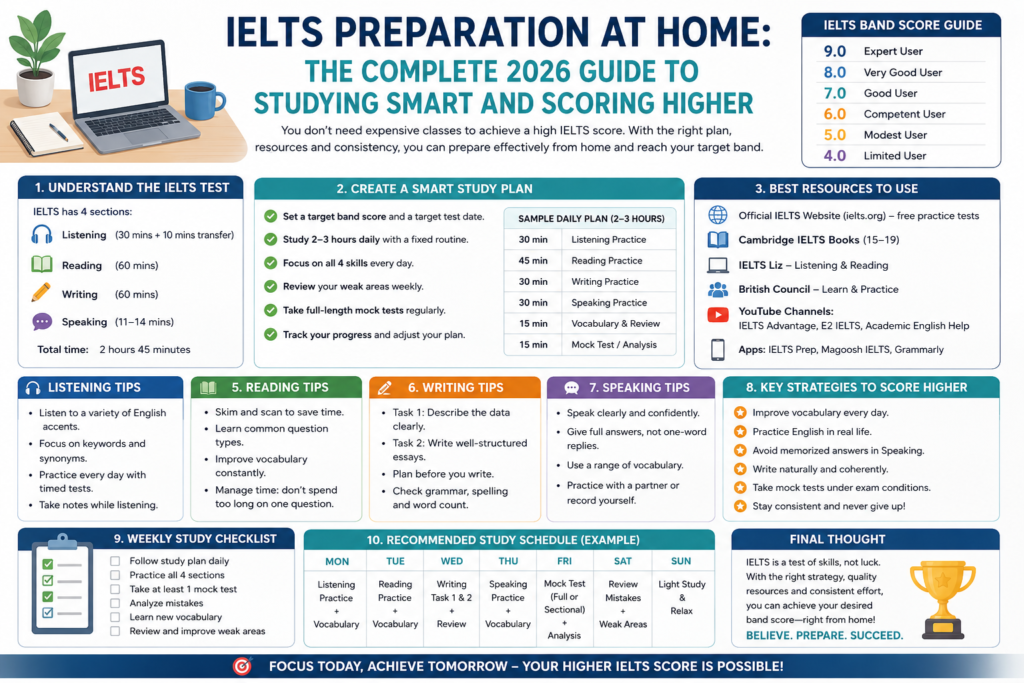
For students who specifically want a detailed self-study approach, use the separate IELTS preparation-at-home guide alongside your tutoring programme rather than replacing structured feedback with self-study alone.
How to Choose the Right IELTS Course Online
Before enrolling, ask the provider a few important questions:
Does the course cover all four IELTS sections?
Listening, Reading, Writing, and Speaking should all be part of your preparation.
Will my Writing receive individual feedback?
Writing correction is one of the most valuable elements of tutor-led IELTS preparation.
Will I get Speaking practice?
Reading model answers is not a substitute for actually speaking.
Is the course personalised?
Your current level, target score, and exam date should influence your study plan.
Can I attend classes around my schedule?
Online learning should provide flexibility rather than create another scheduling problem.
How is progress measured?
Mock tests, tutor feedback, and performance tracking can help you understand whether your preparation is working.
Frequently Asked Questions About IELTS Preparation
Can I prepare for IELTS completely online?
Yes. IELTS preparation can be completed online through live tutoring, practice materials, mock tests, feedback, and independent study. Online preparation is particularly useful for learners who want flexible scheduling or access to tutors regardless of location.
How many hours should I study for IELTS?
The ideal number of hours depends on your starting level and target band. Consistent daily practice is generally more effective than occasional intensive sessions. Your preparation schedule should give additional time to your weakest sections.
Is IELTS tutoring worth it?
For students who need personalised feedback, have a specific target score, or are struggling to improve, tutoring can be highly valuable. A tutor can identify mistakes and weaknesses that are difficult to recognise through self-study.
Which IELTS test should I take?
IELTS Academic is generally used for university and professional registration purposes, while IELTS General Training is commonly used for migration and work-related purposes. Always confirm the exact requirement of the organisation you are applying to.
Can I improve my IELTS Writing score with online tutoring?
Yes. Regular Writing practice combined with feedback on Task Response, Coherence and Cohesion, Lexical Resource, and Grammatical Range and Accuracy can help you understand what is limiting your performance.
How can I improve IELTS Speaking?
Practise speaking aloud regularly rather than preparing answers silently. Work on fluency, pronunciation, vocabulary, grammar, and developing complete answers. Tutor feedback can help identify problems you may not notice yourself.
Does GradeLao offer online IELTS preparation?
Yes. GradeLao offers online IELTS preparation with tutor support for learners preparing for Academic and General Training IELTS. Preparation can be structured around your current level, target band, timeline, and individual learning needs.
Does GradeLao offer other online tuition services?
Yes. Alongside IELTS preparation, GradeLao provides online tuition and preparation for Cambridge, Edexcel, SAT, AKU Board, and Quran education pathways. Explore online tuition services to find the programme that matches your learning goals.
Start Your IELTS Preparation With a Clear Plan
Your IELTS score can influence important academic, professional, and international opportunities, so preparation should be based on more than completing random practice tests.
Start by identifying your required band score, assess your current level, determine your weakest sections, and build a realistic preparation schedule.
If you want structured guidance, personalised feedback, and flexible online learning, GradeLao’s IELTS preparation programme can help you prepare with a plan built around your goals.