
O Level is an internationally recognised secondary-school qualification commonly studied by students aged 14–16. It is often compared with Grades 9 and 10, but the exact equivalent depends on the country, school system, and qualification requirements.
In Pakistan, Cambridge O Level is commonly associated with Classes 9 and 10 and may lead to SSC/Matric equivalence after students meet the relevant requirements. In other countries, it may be compared with different secondary-school grades or stages.
If you’re wondering O Level means which class, how many years it takes, or what comes after O Levels, this guide explains the qualification, age requirements, subjects, grading system, international recognition, and available academic pathways.
Students preparing for their examinations can also explore GradeLao’s online Cambridge O Level tuition for personalised subject support and exam preparation.
What Is O Level?
O Level stands for Ordinary Level. Cambridge O Level is a secondary-school qualification offered by Cambridge International Education as part of its Cambridge Upper Secondary programme.
Rather than one examination covering every subject, students study individual subjects and receive a separate grade for each one. Available subjects include Mathematics, English, sciences, languages, humanities, and business-related disciplines.
Cambridge O Level is used in various countries and education systems. Schools determine how they organise lessons, select subjects, and schedule examinations according to their academic plans.
Students may progress from O Levels to A Levels, other higher-secondary qualifications, or further education programmes, depending on their subject choices and the admission requirements of their intended institutions.
Looking for subject-specific support? Explore Cambridge O Level online tuition at GradeLao to find academic support tailored to your learning needs.
O Level Means Which Class in Different Countries?
O Level does not have one universal class equivalent. Its comparison with local school grades depends on the country’s education structure.
| Country or education system | General comparison |
|---|---|
| Pakistan | Commonly associated with Classes 9 and 10; completed O Levels may qualify for SSC/Matric equivalence subject to requirements |
| England | Often compared with the secondary education stage leading to GCSEs, although O Levels are a historical qualification in England |
| International schools | Commonly studied during the upper-secondary years, often around ages 14–16 |
| Other countries | Grade equivalence varies according to the local education system and recognition rules |
These comparisons are approximate rather than official grade conversions. Universities, education authorities, and schools may use their own recognition criteria.
If you are moving between education systems, check the requirements of the school, university, or authority that will evaluate your qualification.
Is O Level Equal to Grade 10?
O Level is often compared with Grade 10 because students commonly complete the qualification around ages 15–16. However, it is not automatically equal to Grade 10 in every country.
Some schools spread O Level subjects across two years, while others use a different academic schedule. A completed qualification may also be assessed differently from a student who has completed only part of the programme.
Always confirm equivalence with the relevant education authority if you need it for admission, transfer, or certification.
What Is the Equivalent of O Level in Pakistan?
In Pakistan, Cambridge O Level is commonly compared with the secondary-school stage covered by Classes 9 and 10.
Students who meet the requirements of Pakistan’s Inter Board Committee of Chairmen (IBCC) can apply for Secondary School Certificate (SSC), or Matric, equivalence.
For students appearing for O Levels in Pakistan, the standard SSC equivalence subject requirements include eight subjects:
- English
- Mathematics
- Urdu
- Islamiyat
- Pakistan Studies
- Three appropriate elective academic subjects
Students should confirm the latest IBCC rules, subject combinations, and any requirements applicable to their circumstances before selecting subjects or applying for equivalence.
For a more detailed explanation of the local system, read our guide to Matriculation in Pakistan.
What Are O1, O2, and O3?
O1, O2, and O3 are labels commonly used by some schools in Pakistan to divide O Level studies across three academic years.
A school might organise its programme like this:
| School-level label | Approximate stage |
|---|---|
| O1 | First year of the school’s O Level programme |
| O2 | Second year of the school’s O Level programme |
| O3 | Third year of the school’s O Level programme, where applicable |
These labels are school-level conventions, not official Cambridge equivalents of Classes 9, 10, and 11. Other schools may organise their O Level programme over two years.
How Old Are O Level Students?
Cambridge O Level is primarily designed for learners aged 14–16, although Cambridge does not impose a universal mandatory age for candidates.
The age at which students begin or complete O Levels can vary depending on their previous schooling, country, school calendar, and examination plan.
For example, a student transferring from a national curriculum may start at a different age from someone who has followed an international school pathway from the beginning.
Age alone does not determine whether a student can enrol in O Level courses. Students should check the entry and placement requirements of their chosen school.
How Many Years Does O Level Take?
O Level is commonly taught over approximately two years, but the duration can vary by school and individual study plan.
Students may encounter different arrangements, including:
- Two-year programmes: Subjects are taught and examined over two academic years.
- Three-year programmes: Some schools divide the programme into O1, O2, and O3.
- Flexible examination plans: Candidates may sit different subjects in different examination sessions, subject to school arrangements and examination rules.
The number of years a student spends in school does not change the qualification’s official level. What matters is completing the required subjects and examinations for the intended academic pathway.
O Level vs Matric: What Is the Difference?
O Level and Matric are both associated with secondary education, but they belong to different examination systems.
| Feature | Cambridge O Level | Matric in Pakistan |
|---|---|---|
| Qualification | Cambridge O Level | Secondary School Certificate (SSC) |
| Examination system | Cambridge International | Relevant Pakistani education board |
| Typical age | Around 14–16 | Commonly around 14–16 |
| Curriculum | Subject-specific Cambridge syllabuses | National or provincial board curriculum |
| Assessment | Depends on the subject and syllabus | Depends on the relevant board and subject |
| Grading | Cambridge subject grading | Relevant board grading system |
| Further study | A Levels and other eligible pathways | FSc, ICS, ICom, FA, and other eligible pathways |
| Equivalence in Pakistan | IBCC equivalence is required where applicable | Local SSC qualification |
Neither route is automatically better for every student. The right choice depends on the student’s learning preferences, school options, budget, intended subjects, and future plans.
Who Should Consider O Levels?
O Levels may suit students who:
- Want to continue to A Levels.
- Prefer the Cambridge curriculum.
- Need subjects offered through their chosen Cambridge school.
- Are considering applications to universities in different countries.
- Prefer a subject-based international qualification.
Who Should Consider Matric?
Matric may suit students who:
- Plan to continue through Pakistan’s local education system.
- Want a direct pathway to FSc, ICS, ICom, or FA.
- Prefer the curriculum and assessment methods used by local boards.
- Need an option that may be more affordable in their circumstances.
Students should compare the complete cost, teaching quality, available subjects, and further-education requirements before making a decision.
O Level vs IGCSE: Are They the Same?
Cambridge O Level and Cambridge IGCSE are separate qualifications offered for a similar stage of secondary education. Cambridge considers them equivalent grade-for-grade, but their subject availability, syllabuses, and assessment options may differ.
Depending on the subject, assessment may involve written examinations, coursework, practical examinations, or oral components. Students should check the relevant syllabus rather than assume every subject follows the same format.
IGCSE may be worth considering if it is more widely available at the student’s school or offers a subject and assessment combination that better fits their needs.
Explore Cambridge IGCSE online tuition at GradeLao if you need support with subject learning and examination preparation.
What Subjects Can You Study at O Level?
Cambridge offers a broad range of subjects, although availability depends on the school, examination board, and location.
Languages
Language options may include English, Urdu, and other languages available through the relevant syllabus.
Mathematics and Sciences
Common choices include:
- Mathematics
- Additional Mathematics
- Biology
- Chemistry
- Physics
- Computer Science
Students planning to study medicine, engineering, technology, or other science-related fields should research the subjects required for their intended next qualification.
For additional subject support, explore O Level Physics online tuition.
Business and Humanities
Depending on the school’s offerings, students may be able to choose:
- Accounting
- Business Studies
- Economics
- Geography
- History
- Sociology
- Environmental Management
How Should You Choose Your Subjects?
The best subject combination depends on your strengths and future goals. Before selecting subjects, consider:
- The entry requirements for your intended A Level or higher-secondary programme.
- University prerequisites for your preferred degree.
- The subjects available at your school.
- Your interests and academic strengths.
- Any local equivalence requirements that apply to you.
Students in Pakistan who intend to obtain SSC equivalence should verify that their chosen subjects meet the applicable IBCC requirements.
You can also read our O Level subject selection guide for 2027 for further planning advice.
What Is the O Level Grading System?
Cambridge O Level uses subject grades from A* to E, with A* being the highest grade in this grading scale. The exact assessment and grade thresholds depend on the subject and examination session.
Students receive individual grades for their subjects rather than one single grade for the entire O Level qualification.
If you need a local equivalence certificate, the relevant authority may apply its own grade-conversion procedures. Students should check the current rules of the authority responsible for evaluating their qualification.
When Are O Level Exams Held?
Cambridge O Level examinations are commonly offered in the June and November examination series. Subject availability and examination arrangements can vary by syllabus and location.
Students should confirm their examination timetable and entry details with their school or examination centre.
Effective preparation usually includes:
- Reviewing the official syllabus.
- Practising questions from relevant past papers.
- Checking answers against mark schemes.
- Revising topics where marks are regularly lost.
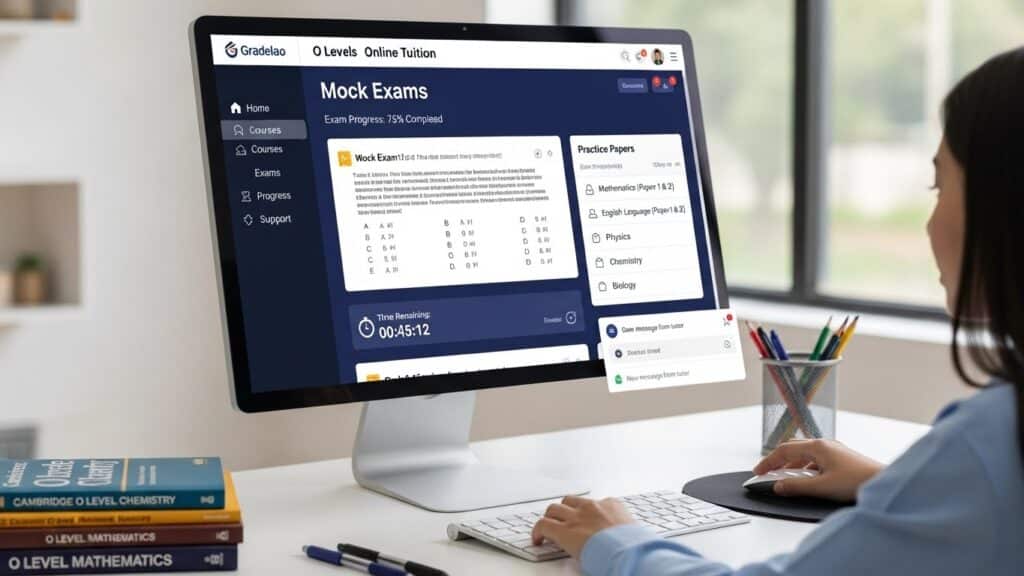
- Completing timed mock examinations.
Need help preparing for your exams? Explore GradeLao’s Cambridge O Level tuition for personalised academic support.
What Comes After O Levels?
After completing O Levels, students can pursue several academic pathways depending on their location, subject combination, grades, and admission requirements.
A Levels
A Levels are a common next step for students continuing along the Cambridge pathway. Students typically select a smaller number of subjects related to their intended university degree or career direction.
For example, students interested in science, engineering, business, or humanities may choose different subject combinations based on university entry requirements.
Explore Cambridge A Level tuition or Edexcel A Level tuition if you are planning your next stage of study.
Local Higher-Secondary Qualifications
In Pakistan, eligible O Level students may also move into programmes such as:
- FSc Pre-Medical
- FSc Pre-Engineering
- ICS
- ICom
- FA
- Other recognised higher-secondary qualifications
Students must meet the applicable equivalence and admission requirements. The correct subject combination can be particularly important when applying for a specific academic group.
Other International Pathways
Depending on the institution and country, students may be able to progress to other upper-secondary qualifications or foundation programmes. Requirements vary, so students should confirm eligibility with their intended school, college, or university.
How GradeLao Can Help With O Level Preparation
Understanding which class O Level corresponds to is only the first step. Students also need a clear plan for learning subjects, revising the syllabus, and preparing for examinations.
GradeLao provides online Cambridge O Level tuition for students looking for personalised academic support. Depending on the tuition arrangement, students can work on difficult concepts, subject revision, and examination preparation with tutor guidance.
GradeLao also offers Cambridge IGCSE tuition and A Level tuition for students following different stages of the Cambridge pathway.
Ready to find suitable academic support? Visit the GradeLao enrollment page to explore available options and request a free one-to-one demo session.
Frequently Asked Questions About O Levels
O Level means which class in simple words?
O Level is a secondary-school qualification commonly compared with Grades 9 and 10. The exact grade equivalent varies by country and education system.
Is O Level equal to Grade 10?
It is often compared with Grade 10 because students commonly complete it around ages 15–16. However, formal equivalence depends on the country and the authority evaluating the qualification.
Is O Level equal to Matric?
In Pakistan, completed O Levels can receive SSC/Matric equivalence if the student meets the relevant IBCC subject and application requirements.
What is O1, O2, and O3?
These are school-level labels used by some schools to divide the O Level programme across three academic years. They are not official Cambridge equivalents of Classes 9, 10, and 11.
Can I study A Levels after O Levels?
Yes. A Levels are a common progression route after O Levels, provided students meet the entry requirements of their chosen school or college.
Can I move to another country’s education system after O Levels?
Potentially, yes. However, the receiving school or authority decides how the qualification is recognised and whether additional subjects, grades, or documentation are required.
Is O Level better than IGCSE?
Neither is universally better. The right choice depends on the specific subjects, syllabus, assessment options, school availability, and future education plans.
Where can I get online O Level tuition?
You can explore GradeLao’s Cambridge O Level tuition and enrollment options to find out more about personalised learning support.
Final Thoughts
O Level is an internationally recognised secondary-school qualification commonly studied around ages 14–16. It is often compared with Grades 9 and 10, but its precise equivalent depends on the local education system and the authority evaluating the qualification.
In Pakistan, completed O Levels can lead to SSC/Matric equivalence when the student meets IBCC requirements. In other countries, students should check local recognition rules before applying to schools, colleges, or universities.
The most important factors are choosing suitable subjects, understanding the requirements of your next qualification, and preparing consistently for examinations.
If you are following the Cambridge pathway and want additional academic support, explore GradeLao’s online O Level tuition or request a free one-to-one demo through enrollment.